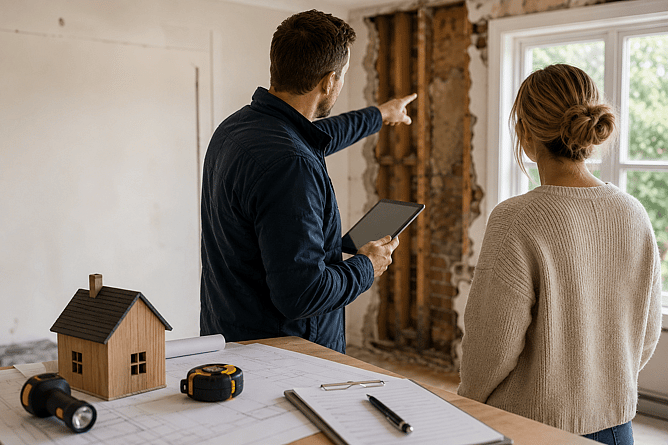
So you've made an offer, got a building report done, and it's come back with a few things flagged.
Before you panic, it's worth knowing this happens all the time. Very few properties, even beautifully presented ones, come back completely clean. It doesn't automatically mean your finance is in trouble, and it definitely doesn't mean the deal is over.
What the bank actually wants to know is how much risk they're taking on by lending against this particular property.
So let’s cover off the best ways to move forward and get a tick of approval – without the stress.
Quantify the problem
The first step is always to find out exactly what you're dealing with. Is it a bit of moisture on a wall, a patch needed on the roof, something minor and easily sorted?
Or is it a bigger issue, like a subfloor problem or something related to cladding, that's going to cost real money to put right? You won't know until you get a builder in to quote it properly. A building report is designed to flag anything and everything that could be a concern, that's its job, but it's not designed to tell you what it'll cost to fix.
We've seen clients read a report full of technical language and assume the worst, nearly walking away from a great property, only to find out the fix was a few hundred dollars and half a day's work. We've also seen the opposite, where something looked like a throwaway line in the report but turned out to need a proper scope of works.
Either way, a builder's quote turns uncertainty into facts the bank can actually work with. That puts a number to what needs to be done and removes assumptions that it’s a huge project costing $1000’s of dollars.
Work out the fix
Once you know the cost, the next question is whether you can fund it and get it done within a reasonable time frame.
Sometimes that means factoring the cost into renegotiations of your offer, or asking the vendor to either fix it themselves before settlement or knock the cost off the price.
Other times, particularly if it's a smaller job, it's simply a matter of scheduling the work in once you've settled and budgeting for it. The key thing banks are looking for is a clear plan and enough funds to complete the project.
It's also worth stepping back and asking whether the issue is as urgent as it first seemed. Building reports are thorough by design, and they'll often flag things that are worth knowing about but aren't actually pressing.
If the numbers are bigger, there are still options. Some clients renegotiate the purchase price to reflect the cost of repairs, assuming there are some additional funds there to cover those costs.
Sort the insurance
The third piece of the puzzle is insurance. Banks want to see an insurance certificate with no exclusions, particularly around anything that's come up in the building report. This is really just another way of showing the bank that the risk on the property is covered, so if something does go wrong down the track, both you and the bank are protected.
Getting this sorted through an adviser or insurance broker is our recommendation, since they'll know exactly what needs to be in place to satisfy the bank, and can guide you in the right direction.
Every lender is different
One last thing worth remembering: every lender looks at these situations a little differently.
What one bank sees as a dealbreaker, another might be entirely comfortable with once the quote and insurance are in hand. Some lenders are more conservative about weathertightness issues, others care more about the requirements around funding repairs, and some will simply want to see the numbers add up.
That’s why we’re big advocates for having options and getting advice – often we can line up finance for someone who may not have been able to get it in place with their bank.
If your building report has thrown up something you're not sure how to handle, we deal with this every day, and there's usually a way through it.
Reach out – we can help!